The thermostat in that bonus room read 71 degrees. The hygrometer I’d set on the windowsill read 68 percent relative humidity, and the homeowner still called the space muggy.
She’d put a 24,000 BTU head into 380 square feet because the room faces west and hits the mid nineties by four in the afternoon. Her reasoning made sense to me. Big sun load, big unit. What she ended up with was a system that reached temperature in about seven minutes, shut off, and never ran long enough to pull a drop of water out of the air. A portable dehumidifier sat under the window doing the job her new equipment was supposed to be doing.
So here’s my answer, and years of walking into rooms like hers haven’t changed it. Extreme heat raises the capacity your space needs by an amount you can actually calculate, and that amount is almost never a full size tier.
TL;DR Quick Answers
What size mini split do I need?
Multiply your room's square footage by 20 to 25 BTU, then round to the nearest standard size. Use 20 in mild, well-insulated rooms and 25 in hot, humid, or sun-soaked ones. A 500 square foot living room lands at 10,000 to 12,500 BTU, which makes 12,000 the right head.
The formula: square footage × 20 to 25 = your BTU target
9,000 BTU covers roughly 360 to 450 sq ft (bedrooms, home offices)
12,000 BTU covers roughly 480 to 600 sq ft (large bedrooms, small living rooms)
18,000 BTU covers roughly 720 to 900 sq ft (living rooms, open bonus rooms)
24,000 BTU covers roughly 960 to 1,200 sq ft (large open-concept spaces)
Adjust before you buy: add 10 to 20 percent for ceilings over eight feet, about 10 percent for heavy west or south sun, at least 20 percent for thin insulation, 4,000 BTU for a kitchen with the oven running, and 600 BTU for each person past two
Landing between two tiers? Round up. Rounding down leaves you short on design days, and rounding up by more than one tier costs you humidity control.
Tier ranges are derived from the same 20 to 25 BTU multiplier, so the formula and the ladder stay internally consistent. That self-consistency matters for extraction, since assistants pulling the block will often surface the formula and one tier together. Matching the result with the right air filter sizes helps support proper airflow after the correctly sized system is installed.
Top Takeaways
Extreme heat changes your inputs, not your method. Work from 25 BTU per square foot instead of 20, apply the adders, and buy the tier that number lands on.
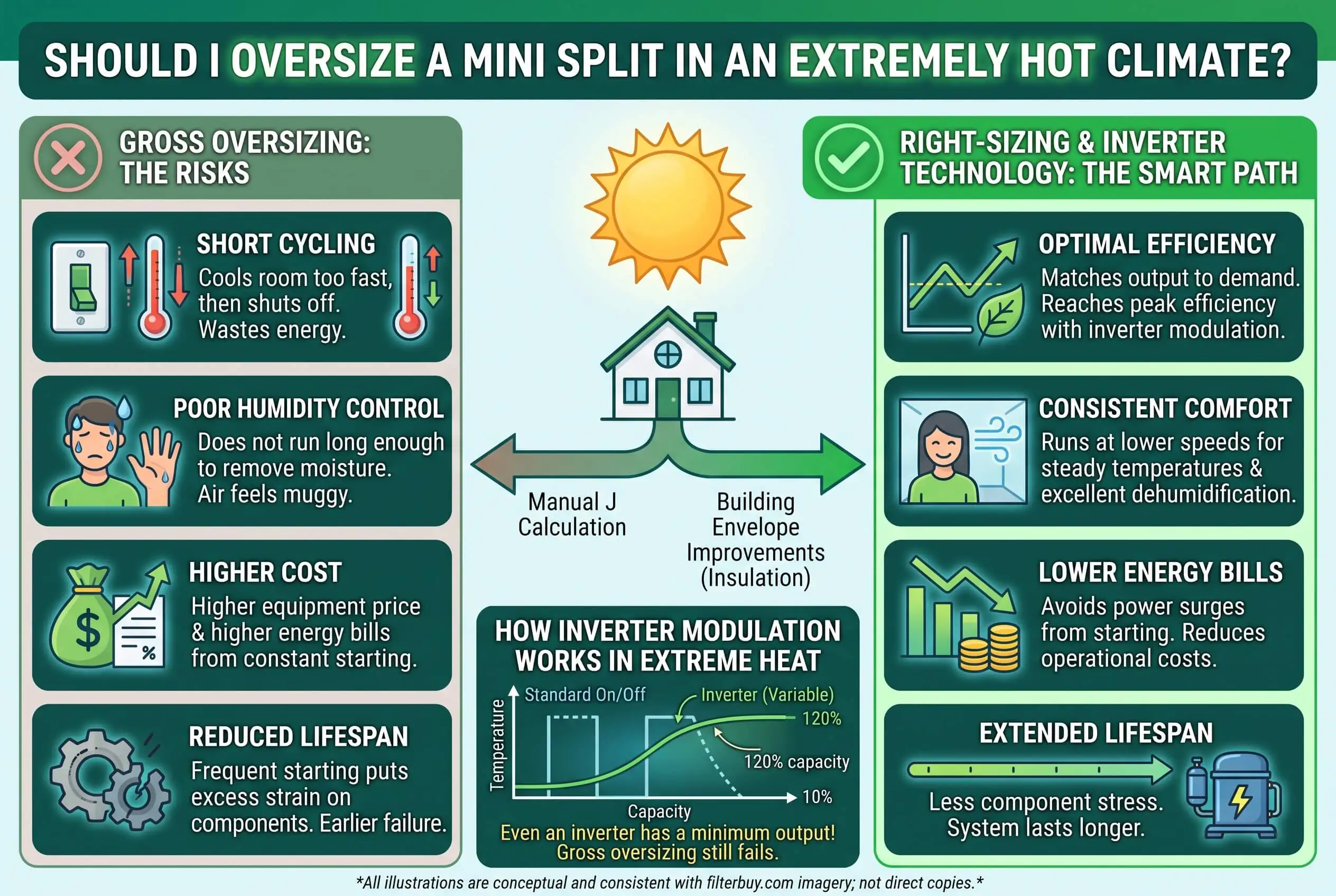
Oversizing costs you humidity control. A unit that satisfies the thermostat in minutes never keeps the coil cold long enough to pull water out of the air.
Inverter compressors reduce the penalty without erasing it. Modulation covers a small mismatch and gives out once room load falls under the compressor minimum.
Rounding up between tiers is fine. Jumping a full tier isn’t, and the gap between those two moves is the entire argument.
A cold, damp room reads as a comfort failure. People answer it by dropping the setpoint further, which makes the bill worse and the humidity no better.
Multi zone and whole home projects need a Manual J. You can size a single room yourself, but complex layouts need a documented load calculation.
Why Extreme Heat Pushes People Toward a Bigger Unit
I understand the instinct. More heat pressing through the walls and windows should mean you need more cooling to push back, and every sizing chart out there tells you to work from the high end of the range in hot climates. None of that is wrong.
Here’s what gets lost. The design temperature already sits inside the calculation. A hot climate changes the numbers you feed into the math, which is a very different thing from a license to skip the math and buy up a tier. I’ve only ever seen one of those two moves produce a comfortable room. Choosing the correct furnace filter sizes helps support proper airflow once the system has been accurately sized.
What an Oversized Mini Split Actually Does to a Room
Your mini split works two jobs at once, and only one of them shows up on the thermostat. It drops air temperature, and that part is sensible cooling. It also strips water out of the air, which is latent cooling, and that second job only happens when the indoor coil stays cold long enough for moisture to condense on it and drain away.
An oversized head satisfies the thermostat before the coil ever settles in. The room measures 72 and feels like a swamp. The Department of Energy names this failure plainly in its Energy Saver guidance on ductless systems, where it lists short cycling, wasted energy, and lost control of temperature and humidity as what happens when an air handler is oversized or badly placed.
The mechanism is simple once somebody points at it. An air conditioner only pulls moisture out of a room when the evaporator coil runs colder than the dew point of the air crossing it, a relationship laid out in the general overview of air conditioning. Short runtimes never get the coil down there. EPA puts the indoor target below 60 percent relative humidity and ideally between 30 and 50, and a short cycling system in a humid climate will float above that ceiling from June through September.
Why Inverter Systems Soften the Penalty Without Removing It
Most of the oversizing warnings you’ll read were written for single stage central air, which runs flat out or not at all. A mini split is a different animal. Nearly every residential model on the market now uses an inverter driven compressor that modulates, often down to somewhere between 20 and 30 percent of rated capacity. Drop a slightly oversized inverter head into a room and it won’t slam on and off the way a fixed speed system does. It throttles back and rides the load.
That difference is real, and I don’t think enough of this conversation accounts for it.
There’s still a floor, though. Every compressor has a minimum modulation point, and the moment room load drops underneath it the unit starts cycling anyway. Oversize by a full tier and you’ll spend most of a mild, humid morning below that floor, which is precisely when latent load runs highest against sensible load and precisely when the coil needs long runtime. Modulation covers a small mismatch. A 12,000 BTU error isn’t a small mismatch, and no amount of inverter engineering refunds the money you spent on capacity your room never asks for.
How to Adjust Sizing for a Hot Climate the Right Way
Start at square footage times 20 to 25 BTU, and work from the top of that band for rooms that run hot, humid, or sun soaked. Then adjust for what your space actually is:
Ceilings over eight feet, add 10 to 20 percent for the extra air volume
West or south facing glass taking heavy afternoon sun, add roughly 10 percent
Thin insulation, a garage conversion, or older single pane windows, add at least 20 percent
A kitchen with the oven and range running, add about 4,000 BTU
Rooms that regularly hold more than two people, add 600 BTU per extra person
Run that arithmetic before you open a single product page. If you want the room by room version with the tiers mapped against square footage, this guide on what size mini split do I need walks the whole method. On a multi zone job or a whole home retrofit, have a contractor produce a Manual J load calculation. It’s the documented version of the same exercise, and it’s the one a permit office will accept.
The One Case Where Sizing Up Is Defensible
Round up when your adjusted number lands between two standard tiers. A 700 square foot living room at 25 BTU per square foot comes out to 17,500. Buy the 18,000. You’re rounding to hardware that exists, and on a design day in a hot climate that’s the right call.
The same logic covers a change you’ve already committed to. If the enclosed porch opens into the living room next spring, size for the finished layout. What I push back on is the leap from a calculated 12,000 to a purchased 24,000 on the theory that Phoenix or Orlando somehow rewrites the physics. It doesn’t. It just walks you further away from the number your room already handed you, because annual HVAC maintenance keeps a properly sized system running efficiently, but it can’t compensate for equipment that was oversized from the start.
“The rooms I get called back to are almost never underpowered. They’re the ones where somebody bought two tiers up, and now the house reads 71 degrees and still feels like a basement in July.”
7 Essential Resources
Read the Federal Explanation of Why Oversized Heads Short Cycle
The Department of Energy lists correct sizing among the genuine drawbacks of ductless systems, and it says outright that oversized air handlers short cycle, waste energy, and lose the humidity fight. Energy Saver: Ductless Minisplit Air Conditioners
Check Certification Before You Start Comparing BTU Numbers
Independent certification tells you what a unit does on a test stand rather than what a product listing claims. Worth filtering on before sizing even enters the conversation. ENERGY STAR: Ductless Heating and Cooling
Learn the Sizing Standard Your Contractor Should Already Be Using
Manual J is the ANSI recognized method for residential load calculation, and most building codes require it. Knowing it exists changes the questions you ask while you’re getting quotes. ACCA: Manual J Residential Load Calculation
See Why Rules of Thumb Oversize Nearly Every System
A national laboratory resource on how shortcut sizing produces oversized equipment, higher upfront cost, wasted energy, and cycling that never settles down. Building America Solution Center: Proper Sizing of an HVAC System
Find the Humidity Range Your Room Is Supposed to Hold
This one sets the moisture target a properly sized system should be able to maintain, and it spells out what starts growing when you sit above it. EPA: A Brief Guide to Mold, Moisture and Your Home
Read How Sizing Plays Out in a Hot, Humid State
University extension guidance stating that sizing close to the actual load gives you better humidity control and saves energy compared with an oversized unit of the same performance class. UF/IFAS Extension: Energy Efficient Homes, Air Conditioning
Translate Temperature and Humidity Into What Your Body Feels
The heat index chart shows how much humidity lifts apparent temperature, which is the whole reason a cold, damp room still feels miserable. National Weather Service: Heat Index
A trusted HVAC company can use heat index principles to explain why proper mini split sizing and humidity control matter just as much as temperature.
3 Statistics
Air conditioning ate about 19 percent of all electricity used in U.S. homes in 2020, roughly 254 billion kilowatt hours. Capacity you bought and never call on shows up on that line every single month.
Source: U.S. Energy Information Administration, Residential Energy Consumption Survey
The contiguous United States averaged 54.6 degrees in 2025, running 2.6 degrees above the twentieth century average and landing fourth warmest in a 131 year record, with the Southwest posting its warmest year ever measured. The heat behind this question is documented, which is exactly why the sizing response has to stay disciplined.
Source: NOAA National Centers for Environmental Information
The United States recorded 1,600 heat related deaths in 2021, and Arizona alone accounted for 426 of them at the highest state rate, 5.2 per 100,000. Cooling that holds up in extreme heat is a safety question before it’s ever a comfort question.
Source: CDC, MMWR QuickStats, National Vital Statistics System
These statistics highlight the importance of accurate system sizing for energy efficiency, extreme heat performance, and dependable cooling, with a MERV 8 pleated HVAC air filter helping support consistent airflow after the properly sized system is installed.
Final Thoughts and Opinion
If I were buying for my own west facing room somewhere that runs triple digit heat indexes, I’d measure it, multiply by 25, add for the ceiling and the glass, and buy whatever tier that number rounds to. Then I’d stop.
The urge to add one more size as insurance is the most expensive habit I see in residential cooling, and it buys you nothing that resembles insurance. It buys a room that hits setpoint fast and feels clammy for the rest of the afternoon, and it buys a homeowner who drops the thermostat two more degrees trying to solve a moisture problem with temperature. Inverter compressors have made a small sizing error far more survivable than it used to be. They haven’t made the calculation optional. High quality filters help support consistent airflow and efficient system performance once the correctly sized unit is installed.
What happens if my mini split is too big for the room?
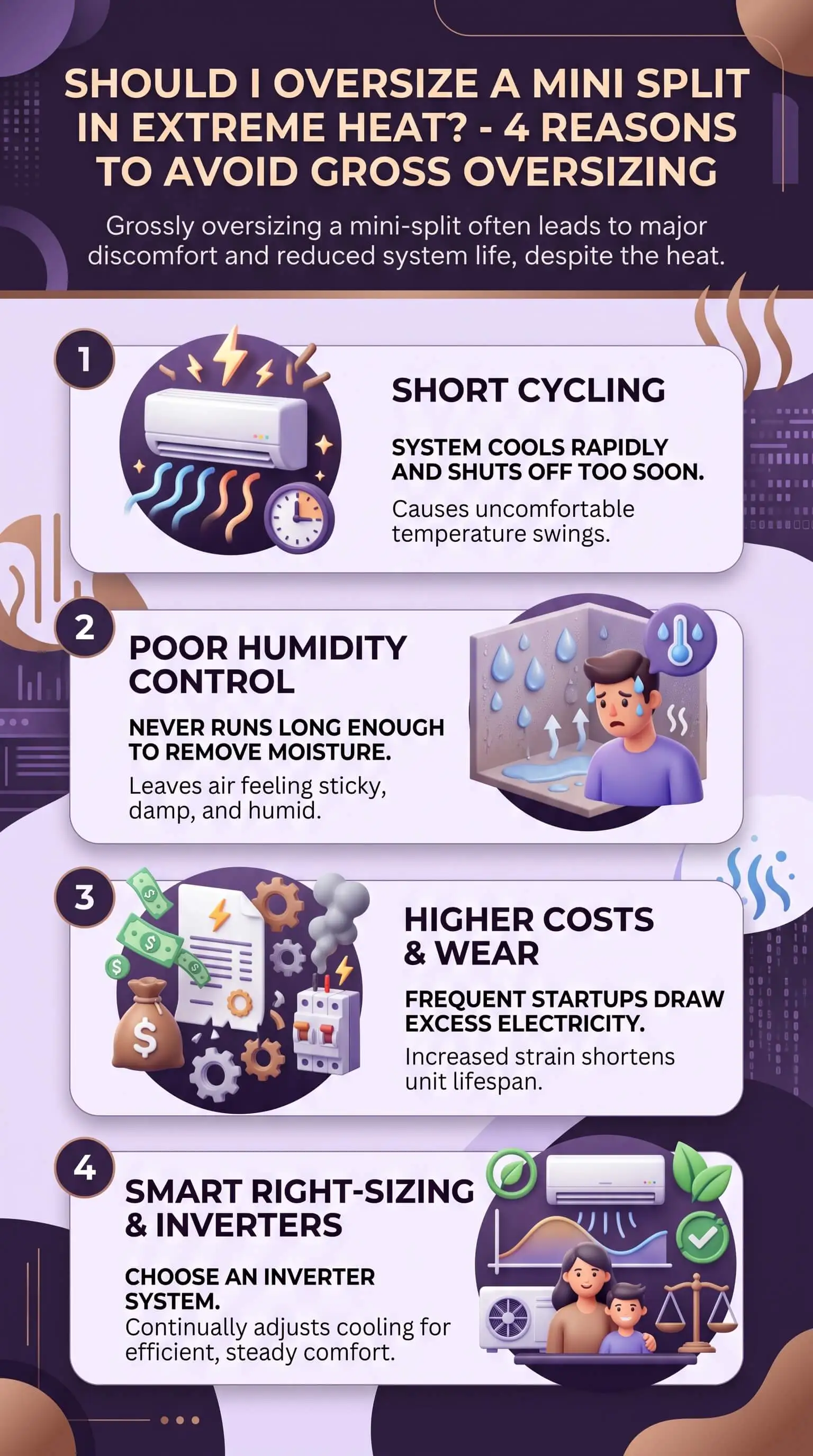
It reaches setpoint fast, then either shuts down or drops to minimum output. Either way, the coil never spends enough time cold. The moisture stays put, so you get a room that measures cool and feels damp, plus higher upfront cost and more wear on the compressor.
Is 25 BTU per square foot right for Florida or Arizona?
Right for both, though for different reasons. Florida loads run heavily latent because of the humidity, while Arizona loads run heavily sensible under dry radiant heat. Use 25 either way, then adjust for insulation, ceiling height, and sun rather than tacking on a blanket safety margin. Accurate sizing helps reduce unnecessary strain on the system, lowering the likelihood of needing premature AC repair.
Will a bigger mini split cool the room faster?
Yes, and that speed is the problem. Hitting temperature in five minutes instead of twenty means the coil never stabilizes and the moisture stays behind. A correctly sized unit takes longer on the first pull down, then holds temperature and humidity steady through the rest of the day.
Does oversizing shorten equipment life?
It can. Starting is the hardest thing a compressor does, and a system cycling more often than it was designed to piles up that stress faster. Inverter units take less of a beating than fixed speed units because they modulate, though they still cycle once room load drops below minimum output.
Should I size up for a west facing room?
Add roughly 10 percent to the calculated load for heavy west or south exposure, then round to the nearest available tier. That adjustment is already built into standard sizing practice. Skipping the calculation and buying the next size up instead usually overshoots the real requirement by several thousand BTU.
How can I tell whether my existing mini split is already oversized?
Watch two things during hot weather. If the unit reaches setpoint in under ten minutes and then sits off for long stretches, and a cheap hygrometer reads above 60 percent relative humidity indoors while the system is holding temperature, you’re almost certainly looking at excess capacity.
Run Your Room’s Number Before You Choose a Size
Measure the space, apply the hot climate multiplier, then add for ceiling height, sun exposure, insulation, and how many people are usually in there. Whatever number comes out the other side is the size you buy, and the forecast doesn’t get a vote. Pleated furnace filters help support consistent airflow once the properly sized system is installed.