That scenario plays out across ZIP codes 32701, 32714, 32716, and 32751 more than any other single call type we receive. And the part that stands out every time isn't the failure. It's what happened in the weeks before it. The system was communicating. It almost always is. The signs were there — a bill that crept up fifteen dollars month over month, a back bedroom that stopped keeping up, a faint musty smell that appeared when the system first kicked in in the morning. Things easy enough to rationalize. Things that, in a cooler climate with a real off-season, might have stayed minor.
In Altamonte Springs, they don't stay minor. A seven-month cooling season with no recovery window means small issues compound on a timeline that national HVAC guidance doesn't account for. A borderline capacitor in April becomes an emergency replacement in July. A drain line showing early congestion in May backs up in August. A coil that needed cleaning before the season started spends seven continuous months losing efficiency — and the homeowner, feeling cool air from the vents, has no idea until the energy bill tells them.
Here's what we've learned from responding to these calls for years in this market: the warning signs of an overdue HVAC system in Altamonte Springs are specific, recognizable, and almost always visible before the failure — if you know what you're looking at.
What this page covers:
The warning signs Altamonte Springs homeowners most commonly miss — and what's actually driving them
Why Florida's seven-month season compresses the warning timeline compared to national guidance
How to tell the difference between a system that needs a scheduled visit and one that needs attention now
What a legitimate maintenance visit should address when these signs are present
How to confirm the contractor you call for top HVAC system maintenance near Altamonte Springs FL is qualified to service what this market actually demands
TL;DR Quick Answers
Top HVAC System Maintenance Near Altamonte Springs FL
Top HVAC maintenance in Altamonte Springs means catching the warning signs before they become an emergency call. A documented 24-point inspection, a 60–90 minute visit, and a written summary of findings before the technician leaves your driveway. One annual visit isn't enough for a market with a seven-month cooling season. Twice yearly is the standard this climate demands.
The warning signs most Altamonte Springs homeowners miss — and what they actually mean:
Climbing energy bill since May — not a weather story, a maintenance story. Coil contamination, refrigerant drift, or filter bypass shows up on your FPL bill before it shows up anywhere else.
Room that won't reach set temperature — almost always coil contamination, airflow restriction, or refrigerant drift. Not summer heat.
Musty smell on startup — biological, not mechanical. A partially congested drain line creating growth conditions inside the air handler. The smell fades. The problem doesn't.
Sounds the system didn't make last season — clicking, rattling, short cycling, squealing from the blower motor. Each points to something specific. None resolve on their own in a seven-month season.
Humidity heavier than normal despite continuous operation — drain line congestion reducing moisture removal capacity. In Seminole County humidity, that's a health issue before it's a comfort issue.
Why Altamonte Springs warning signs close faster than anywhere else:
Seven-month cooling season with no recovery window — small problems compound continuously
Oak and pine pollen fills filters in 3–4 weeks — not 90 days — sending debris directly onto the evaporator coil
Seminole County humidity regularly approaches the 60% mold-growth threshold — a missed drain flush doesn't stay manageable for long
70–90% of AC systems carry at least one performance-compromising fault — the default assumption for any home without a documented maintenance record should not be that everything is fine
What separates a real maintenance visit from one that just looked like one:
Verified Florida state license — confirm at MyFloridaLicense.com before anyone enters your home
60–90 minute visit — under 30 minutes means the full job wasn't done
24-point documented inspection covering coils, drain line, capacitor, refrigerant, blower motor, and electrical connections
Written summary of findings handed to you before the technician leaves — no documentation means no proof
Seminole County-specific experience — a contractor who knows this market answers questions about pollen loads, drain congestion patterns, and seven-month season demands without hesitation
Top Takeaways
The warning signs of an overdue HVAC system in Altamonte Springs are quiet — not dramatic — and they follow a predictable pattern that closes faster than most homeowners expect. A climbing energy bill, a room that won't cool, an unfamiliar sound, a musty smell on startup — these are not separate inconveniences to monitor. They are a sequence. In a market with a seven-month cooling season and no recovery window, each signal has a shorter timeline than it would anywhere else. Acting before the sequence completes is the difference between a scheduled maintenance visit and an emergency call on the hottest Saturday of the year.
The air feeling cool is not the same as the system working correctly. This is the most common form of false confidence we encounter across 32701, 32714, 32716, and 32751 — and the one that most consistently precedes the failures we respond to. All of these can exist inside a system still producing cool air:
A coil losing heat absorption capacity month by month
A drain line approaching backup
A capacitor weeks from failure
An energy bill quietly reflecting every one of them
Cool air is not documentation. A written summary of findings is.
In Altamonte Springs, your HVAC system is your family's primary air quality system for more than half the year — not just a comfort appliance. The EPA documents that Americans spend approximately 90% of their time indoors, with indoor pollutant concentrations often 2 to 5 times higher than outdoor levels. A system with a contaminated coil or standing water in the drain pan isn't just inefficient. It's circulating whatever has accumulated inside it through every vent in your home — affecting every breath your family takes from April through October.
Between 70–90% of AC systems carry at least one performance-compromising fault from installation or inadequate maintenance. That range is consistent with what our technicians find as the second or third contractor into a Seminole County home. What it means practically:
The default assumption for any Altamonte Springs home without a documented twice-yearly maintenance history should not be that everything is fine
A receipt from last year's visit without a written summary is not evidence of a well-maintained system — it's evidence a contractor was there
The warning signs on this page are not edge cases — they are the expected condition of a home without a current maintenance record
Every warning sign on this page is preventable — but only before the timeline closes. The drain line backing up in August was showing early congestion in May. The capacitor that failed in July was borderline in April. The coil driving energy bills all summer needed cleaning before the season started. What each one required to prevent:
A documented maintenance visit at the right point in the season
A written summary of findings confirming the work was completed
A schedule built around what this market demands — not the national average
Not more service. The right HVAC service, at the right time, is documented every time.
The most common thing homeowners tell us after an emergency service call is that they noticed something felt off — they just didn't know what it meant.
That's the gap this page is designed to close.
In Altamonte Springs, HVAC systems don't typically fail without a warning period. What changes in a market with a seven-month cooling season is how quickly that warning period closes. A sign that might give a homeowner in a cooler climate several months to act gives an Altamonte Springs homeowner several weeks — because the system never stops running long enough for small problems to stay small.
Here's what to watch for.
Your Energy Bill Is Climbing Without an Obvious Explanation
This is the sign we see most consistently in the weeks before a maintenance-related failure. Not a dramatic spike — a steady, quiet climb. Fifteen dollars one month. Twenty the next. The kind of increase is easy to attribute to summer heat rather than system performance.
What's actually happening in most cases:
A dirty evaporator coil has lost its ability to absorb heat efficiently — the system runs longer cycles to reach the same temperature
A refrigerant level that's drifted off-spec is forcing the compressor to work harder than designed
A clogged filter has reduced airflow enough to meaningfully increase energy consumption — the U.S. Department of Energy documents a 5–15% energy increase from a dirty filter alone
Duct leakage is sending conditioned air into unconditioned spaces while the system compensates
What makes this sign particularly easy to miss in Altamonte Springs is that summer energy bills are already elevated. Air conditioning accounts for 28% of total home energy use in Florida — the highest of any state. A system quietly losing efficiency blends into a bill that's already high.
What we've found in homes across 32701 and 32714: when we pull the energy history alongside the maintenance history, the two lines almost always tell the same story. The bill started climbing around the same time the last documented maintenance visit was due.
If your energy bill has increased month over month without a corresponding change in usage, your system is working harder than it should. That's a maintenance conversation — not a weather conversation.
The Air Feels Different — Even When the Temperature Looks Right
This is the sign homeowners most often dismiss. The thermostat says 74 degrees. The air is coming out of the vents. Everything looks like it's working.
But the house feels heavier than it should. Certain rooms never quite reach the set temperature. The air has a faint staleness to it that wasn't there last season. Humidity feels higher than normal despite the system running continuously.
Each of these points to something specific:
Rooms that won't cool down typically indicate airflow issues — a dirty coil reducing heat absorption, a blower motor operating below capacity, or duct leakage diverting conditioned air before it reaches the space
Heavy or humid air often points to a drain line issue. In Seminole County, condensate drain lines are the single most common maintenance call we receive. A partially congested drain reduces the system's ability to remove moisture from the air — and in a climate where indoor humidity regularly approaches the 60% mold-growth threshold, that's not a comfort issue. It's a health issue.
Stale or musty odors when the system kicks on are almost always biological. Moisture that isn't draining properly creates conditions inside the air handler where mold and bacteria grow — and the system then distributes whatever is growing through every vent in the house. We've walked into homes in 32716 and 32751 where this had been building for an entire season. The homeowner noticed the smell but assumed it was the ductwork.
When the air feels wrong even when the temperature looks right, the system is telling you something the thermostat can't.
The System Is Making Sounds It Didn't Make Last Season
HVAC systems in good working condition operate with a consistent, predictable sound profile. When that profile changes, something has changed mechanically.
Sounds worth taking seriously:
Clicking at startup or shutdown beyond normal cycling — often indicates a failing capacitor. We find more borderline capacitors in April than any other month of the year. A capacitor that's struggling to start the compressor in spring will fail under the load of a July peak day.
Rattling or vibrating from the air handler or outdoor unit — loose components, debris in the system, or a blower wheel that's out of balance. Left unaddressed in a continuously running system, small mechanical issues become expensive ones.
Squealing or grinding from the blower motor — bearing wear or belt degradation. In a system running seven months continuously, blower motor wear accelerates beyond what national service intervals account for.
Short cycling — the system turning on and off more frequently than normal — typically signals an airflow restriction, refrigerant issue, or a system working too hard to maintain temperature in deteriorating coil conditions.
None of these sounds resolve on their own in Altamonte Springs. The season doesn't give the system time to recover. A sound that starts in May is a more serious problem by August.
The System Is Running Constantly But the House Isn't Comfortable
There's a meaningful difference between a system that runs frequently because it's hot outside and a system that runs constantly because it can't keep up.
In Altamonte Springs, the line between those two conditions is easy to miss — because continuous operation is normal here in ways it isn't in cooler markets. But there are specific indicators that continuous operation has crossed from normal into problematic:
The system runs for extended periods without the thermostat satisfying
Temperature differential between the supply air and return air is lower than expected — a sign the coil isn't absorbing heat effectively
The outdoor unit runs non-stop while indoor comfort continues to decline
Energy consumption is high but comfort output is low
What we find in these homes almost universally: a coil that hasn't been cleaned, a refrigerant charge that's drifted, or a drain line partially congested enough to affect system performance without triggering a full shutdown.
The system isn't broken. It's compromised — and running continuously trying to compensate. In a market where seven months of that compensation pattern plays out on a single coil and a single drain line, the gap between compromised and broken closes faster than most homeowners expect.
How Long Has It Been Since Your Last Documented Maintenance Visit?
This is the question that sits underneath every sign above.
Not just when the last visit was — but whether that visit was documented. Whether a written summary of findings was provided. Whether the drain line was actually flushed, the coil actually cleaned, the capacitor actually tested.
In our experience across Seminole County, the systems showing the warning signs above fall into two categories:
Systems that haven't been serviced in over a year
Systems that have a receipt from a visit that wasn't fully completed
Both are overdue. The second category is harder to identify — and more common than most homeowners realize.
If you're seeing any of the signs described on this page, the right next step isn't to wait and monitor. In a market where a seven-month season compresses every warning timeline, a system communicating that it needs attention in May needs that attention before June — not after the first emergency of summer confirms it.
"After years of responding to emergency calls across Altamonte Springs, the pattern is always the same. The homeowner noticed something weeks earlier — a bill that crept up, a room that stopped keeping up, a smell that came and went on startup. They rationalized every one of those signals because the air still felt cold and the thermostat still read the right number. What they didn't know is that in a market with a seven-month cooling season and no real recovery window, a system communicating that something is building in May is a fundamentally different situation than the same signal in a climate where the system shuts down for the winter and gets a chance to recover. The warning period here is real — but it's shorter than most homeowners expect, and it closes faster than any national maintenance guide will tell you. The signs on this page aren't hypothetical. They're the last thing we see documented on every service call before the emergency that followed it."
Essential Resources
We live and work in Seminole County too. When our neighbors ask how to stop worrying about their AC and make a confident, informed decision about who maintains it — and whether their system is actually being taken care of — these are the seven resources we share. The same ones we'd put in front of our own families.
1. The First Step Before Any Contractor Enters Your Home
Florida law requires every HVAC contractor working in your home to hold an active state license. This free tool confirms credentials, license status, and disciplinary history in under 60 seconds. We've seen homeowners across 32701 and 32714 pay for full-season maintenance from contractors not legally authorized to perform it. Verify before you book. Every time. https://www.myfloridalicense.com/wl11.asp
2. The Checklist That Tells You Whether You Got More Than Just an Inspection
The federal government's official standard for what a qualified HVAC contractor should complete on every visit. Print it. Bring it. A technician doing the job right won't mind going through it line by line — and every task that protects your Altamonte Springs home through a seven-month cooling season is right there on the list. https://www.energystar.gov/saveathome/heating-cooling/maintenance-checklist
3. What Your System Actually Needs to Get Through an Altamonte Springs Summer
The U.S. Department of Energy's complete guide to what proper AC maintenance covers — from coil cleaning and drain line flushing to refrigerant verification and airflow checks. In a market where your system runs April through October without a real break, understanding what optimized performance looks like is the first step to knowing whether your system is actually getting it. https://www.energy.gov/energysaver/maintaining-your-air-conditioner
4. Know What You're Entitled to Before a Contractor Sets Foot in Your Home
The Florida DBPR's consumer guidance covers homeowner rights, contractor verification, and how to file a complaint if the work was substandard or incomplete. We've walked into Altamonte Springs homes after contractors who invoiced for tasks they never completed. This resource exists so you know what to do if that happens to you — before it costs you a summer. https://www.myfloridalicense.com/DBPR/os/documents/consumer_pamphlet.pdf
5. Why a Skipped Drain Line Flush in Altamonte Springs Is a Health Decision — Not Just a Mechanical One
The EPA's guide to mold and moisture explains how unmaintained systems allow biological growth to take hold inside air handlers and distribute through every vent in the house. In Seminole County — where humidity regularly approaches the 60% mold-growth threshold — a congested drain line isn't an inconvenience. It's the fastest path to a remediation event that costs more than three years of Care Plan coverage combined. https://www.epa.gov/mold/brief-guide-mold-moisture-and-your-home
6. The Data That Explains Why Every Maintenance Decision Costs More in Florida Than Anywhere Else
Air conditioning accounts for 28% of total home energy use in Florida — the highest of any state in the nation. The EIA's Florida energy profile puts the financial reality of HVAC inefficiency into direct context. In Altamonte Springs, every percentage point of lost performance from a dirty coil or off-spec refrigerant charge compounds across seven months of continuous cooling — and shows up on your FPL bill every single month. https://www.eia.gov/state/print.php?sid=FL
7. The Care Plan Built for What Altamonte Springs Actually Demands — Not What Works Somewhere Else
Rated 4.8 stars across 742 Google reviews, our Care Plans were built around one goal: stop worrying about your AC and let us do that for you. Two annual visits, drain line flushes, coil cleaning, documented 24-point inspections with written summaries of findings, and 24-hour emergency response. Plans start at $149 per year. We serve ZIP codes 32701, 32714, 32716, and 32751 — and every visit ends with documentation that tells you exactly what was done and exactly what to expect going into the next season. That's what Better Air For All means to us in Altamonte Springs. https://hvac.filterbuy.com/service-areas/florida/altamonte-springs-fl/annual-preventative-ac-maintenance-service-care-plans/
These trusted local and federal resources highlight the value of regular HVAC maintenance in Altamonte Springs—empowering homeowners to verify qualified contractors, follow proven service standards, protect indoor air quality, reduce high Florida cooling costs, and maintain a documented plan that keeps their system efficient, reliable, and worry-free all year long.
Supporting Statistics
We don't pull these numbers out to make a case. We share them because they're the data behind what our technicians see when they open an air handler that hasn't been properly serviced in Altamonte Springs — and because understanding what the research actually says about systems like yours, in a climate like this one, changes how you think about every warning sign on this page.
Stat #1: Americans spend approximately 90% of their time indoors — and indoor pollutant concentrations are often 2 to 5 times higher than outdoor levels.
When a homeowner calls because something smells off when the system kicks on, the first thing we do isn't reach for a diagnostic tool. We ask how long it's been since the drain line was flushed and when the coil was last cleaned. After years of service calls across 32701, 32714, 32716, and 32751, we already know what the answer usually is.
The EPA documents that Americans spend approximately 90% of their time indoors — with indoor pollutant concentrations frequently running 2 to 5 times higher than outdoor levels. In Altamonte Springs, where your system runs April through October without a meaningful break, that statistic lands differently than it does anywhere else.
What it means in practice for a Seminole County home:
Your HVAC system isn't a comfort appliance — it's your family's primary air management mechanism for more than half the year
A contaminated coil or compromised air handler isn't just losing efficiency — it's circulating whatever has built up inside it through every vent in your home
Children, elderly family members, and anyone with respiratory sensitivities are the most exposed — they spend the most time indoors and breathe the most air relative to body weight
The musty smell on startup isn't a ductwork quirk — it's biological contamination becoming airborne the moment the system turns on
We've been inside Altamonte Springs homes where a family had been breathing air conditioned by a system with standing water in the drain pan and a coil untouched for over a year. The house felt cool. No one suspected anything. The EPA's data explains why the gap between "feels fine" and "actually fine" is the most important — and most overlooked — gap in residential HVAC maintenance.
Source: U.S. Environmental Protection Agency — Indoor Air Quality https://www.epa.gov/report-environment/indoor-air-quality
Stat #2: Indoor humidity above 60% creates conditions for mold growth — and a contaminated HVAC system can distribute biological contaminants through an entire home.
The condensate drain line is the most unglamorous item on any maintenance checklist. It's also the one we discuss most often when explaining to Altamonte Springs homeowners why their air smells wrong, why allergies have gotten worse indoors, or why there's unexplained moisture near the air handler.
The EPA is direct: indoor humidity above 60% accelerates mold growth. A contaminated central air system becomes a breeding ground — then distributes what's growing through every vent. EPA mold remediation guidance adds that condensate drain pans must be checked routinely because they become reservoirs for mold and bacteria when not properly maintained.
The progression we see in Seminole County homes is gradual, predictable, and almost always preventable:
Drain line accumulates buildup through months of continuous operation — not a dramatic clog, just progressive narrowing
System's moisture removal capacity decreases as drain function is compromised
Indoor humidity climbs in ways that feel like "it's just the weather"
Air handler begins holding moisture it can no longer properly drain
Standing water in the condensate pan creates biological growth conditions inside the unit
System continues running — distributing what's grown through every vent
Homeowner notices a musty smell on startup and assumes it's the ductwork
Every step is preventable with a drain line flush performed before the cooling season starts and again after it ends. It's why flushing the drain line is a standard line item on every Filterbuy HVAC Solutions visit — not an add-on, not an upsell, a baseline requirement for maintaining a system in a climate where this progression happens faster than any national maintenance calendar accounts for.
Source: U.S. Environmental Protection Agency — Biological Pollutants' Impact on Indoor Air Quality https://www.epa.gov/indoor-air-quality-iaq/biological-pollutants-impact-indoor-air-quality
Stat #3: Dirty filters and coils are among the top causes of HVAC system malfunction — and can lead to premature compressor or fan failure.
The U.S. Department of Energy identifies dirty filters and coils as primary drivers of HVAC malfunction — and documents that when left unaddressed, they lead directly to premature compressor or fan failure. Here's what that looks like from inside an Altamonte Springs home where the warning signs went unaddressed for a season.
The compressor that failed on a Saturday afternoon in July didn't fail without warning. The homeowner had noticed the energy bill climbing since May. They noticed the back bedroom never kept up. They noticed the system running longer than it used to. They rationalized every signal because the air still felt cool.
What was actually happening:
A coil uncleaned before the season started was accumulating pollen and debris from April forward — reducing heat absorption capacity month by month
A filter loaded in three weeks rather than ninety days had been bypassed — sending debris directly onto the coil
Short cycling had started — the system turning on and off more frequently as it struggled to reach set temperature
The compressor was working harder than designed — every day, for three months — before it failed on the hottest day of the year
We replaced that compressor. We've replaced others like it. In almost every case the warning signs were present for weeks. The climbing bill. The room that wouldn't cool. The system runs constantly without satisfying. Not dramatic signals — quiet ones that compound on a timeline this market doesn't give you room to ignore.
Source: U.S. Department of Energy — Common Air Conditioner Problems https://www.energy.gov/energysaver/common-air-conditioner-problems
Stat #4: Between 70–90% of AC systems in U.S. homes have at least one performance-compromising fault from installation or inadequate maintenance — rising to 90–100% when duct leakage is included.
This is the statistic that gives every warning sign on this page its real weight.
DOE and National Renewable Energy Laboratory research — spanning two decades of field studies — consistently found that 70–90% of AC systems carry at least one performance-compromising fault from installation or inadequate maintenance. When duct leakage is factored in, that range rises to 90–100%.
We cite it because it maps directly to what our technicians find as the second or third contractor into a Seminole County home — and because it reframes what the warning signs above actually mean.
What 70–90% looks like from the field:
A system running constantly but not keeping up almost certainly has an unaddressed fault — not a hot day explanation
An energy bill climbing since May is almost certainly a maintenance story — not a weather story
A receipt from last year's tune-up without a written summary is not evidence the system is in good shape — it's evidence a contractor was there
The default assumption for any Altamonte Springs home without a documented twice-yearly maintenance history should be that something needs attention
What years of service calls in this market have taught us: the warning signs on this page are not edge cases. In a market where 70–90% of systems carry at least one unaddressed fault — across a seven-month season with no recovery window — they are the expected condition of a home without a current, documented maintenance record.
The written summary of findings we provide after every visit isn't paperwork. It's documented proof your system is on the right side of a very unfavorable range — and the only thing that gives you, and every technician who services your home after us, an accurate picture of where things actually stand.
Source: U.S. Department of Energy — Residential HVAC Installation Practices: A Review of Research Findings https://www.energy.gov/eere/buildings/articles/residential-hvac-installation-practices-review-research-findings
The EPA and DOE data make clear the importance of annual maintenance for your HVAC system in Altamonte Springs—protecting indoor air quality, controlling humidity before mold conditions develop, preventing coil and compressor failure from dirt buildup, and correcting the performance faults that affect up to 90% of systems before they quietly turn into costly breakdowns.
Final Thought & Opinion
Here's the thing about warning signs: they only work if you know what you're looking at.
The homeowners who end up in the most difficult situations aren't careless people. They're attentive people who noticed something and didn't have the context to understand what it meant. The bill that crept up fifteen dollars a month. The back bedroom that stopped keeping up. The smell on startup faded after a few minutes.
They saw every signal. They just didn't know that in a market with a seven-month cooling season, those signals have a shorter timeline than anywhere else in the country.
Our honest opinion, formed after years of service calls in this specific market:
The warning signs of an overdue HVAC system in Altamonte Springs aren't dramatic. They're quiet. They're easy to rationalize. And they follow a pattern predictable enough — once you've seen it enough times — that we can tell you with reasonable confidence what comes next if they go unaddressed:
The climbing energy bill that started in May becomes the compressor that fails in July
The musty smell on startup becomes the mold remediation that costs more than three years of preventive care combined
The room that won't cool becomes the emergency weekend call on the hottest Saturday of the year
None of those outcomes are inevitable. Every one of them is preventable — but only if the warning is recognized before the timeline closes.
What we've learned specifically about this market that national guidance doesn't capture:
Altamonte Springs systems don't get a recovery window. A warning sign that stays minor in a climate with real off-season compounds here across seven continuous months of operation.
The 70–90% fault rate of DOE research documents isn't an abstraction. It's the condition of most homes we enter as the second or third contractor — homes where a receipt existed but documentation didn't.
The air feeling cool is not the same as the system working correctly. It's the most common form of false confidence we encounter — and the one that most consistently precedes the emergency call.
Florida's 28% household energy share for air conditioning means every percentage point of degraded efficiency shows up on a bill that's already the highest in the nation. The warning signs above aren't just comfort indicators. They're financial ones.
The opinion we'd share with any neighbor on any street in Altamonte Springs:
Don't wait for a failure to confirm what the warning signs were already telling you.
A system communicating through a climbing bill, a room that won't cool, an unfamiliar sound, or a smell that comes and goes on startup is not a system that needs monitoring. It needs attention. In this market the gap between "needs attention" and "failed on the hottest day of the year" is measured in weeks — not months.
Here's what acting on the warning signs actually costs versus what ignoring them costs:
A spring visit that catches a borderline capacitor in April costs a fraction of the emergency replacement it prevents in July
A drain line flush that takes twenty minutes prevents the mold remediation event that takes days and thousands of dollars
A written summary of findings before a seven-month season gives you the baseline that makes every future decision about your system informed — not a guess
We've built every Filterbuy HVAC Solutions Care Plan around that principle. Not more service than necessary. The right service, on the right schedule, is documented every time.
In Altamonte Springs, a well-maintained system isn't a luxury. It's the difference between a home that protects your family through a Florida summer and one that quietly compromises the air they breathe while appearing to work just fine.
That's what Better Air For All means to us in ZIP codes 32701, 32714, 32716, and 32751. Not just the absence of failure. Documented, verified, confident protection — for every family in every home we serve.
FAQ on Top HVAC System Maintenance Near Altamonte Springs FL
Q: What are the most common signs my HVAC system is overdue for maintenance in Altamonte Springs, FL?
A: The signs we see most consistently in the weeks before a maintenance-related failure are quiet, easy to rationalize, and follow a sequence we've learned to recognize across 32701, 32714, 32716, and 32751.
The sequence that precedes most failures we respond to:
Climbing energy bill without a usage change. Not a spike — a steady month-over-month creep. When we pull energy history alongside maintenance history in Altamonte Springs homes, the two lines almost always match. The bill started climbing when the last documented visit was due.
A room that won't reach a set temperature. Almost always the back bedroom or space furthest from the air handler. Almost always coil contamination, airflow restriction, or refrigerant drift — not just summer heat.
Musty smell when the system first kicks on. This is biological, not mechanical. A partially congested drain line creates growth conditions inside the air handler. The system distributes it through every vent. The smell fades after a few minutes — not because the problem resolves, but because the initial concentration disperses.
Sounds the system didn't make last season. Clicking beyond normal cycling, short cycling, rattling from the air handler, squealing from the blower motor. Each points to something specific. None resolve on their own in a market where the system never stops running long enough to recover.
Humidity that feels heavier than normal despite continuous operation. A partially congested drain line reduces moisture removal capacity. In Seminole County — where humidity regularly approaches the 60% mold-growth threshold — that's not a comfort issue. It's a healthy one.
If you're seeing more than one of these simultaneously, the system isn't asking to be monitored. It's asking to be serviced.
Q: How quickly can a warning sign become a serious HVAC problem in Altamonte Springs, FL?
A: Faster than national guidance prepares most homeowners for. In cooler climates, a warning sign in May might stay minor through summer. In Altamonte Springs, that same sign is operating inside a system running continuously for five more months. Small problems don't stay small here. They compound.
The timeline we see play out most often:
Warning sign appears in May — climbing bill, unusual sound, room that won't cool
Homeowner rationalizes — it's just the heat, the air still feels cool, the system still turns on
Underlying issue develops through continuous operation — coil accumulates contamination, drain line narrows, capacitor stress increases under daily load
System reaches failure point under peak load — typically the hottest period of July or August
Emergency call — weekend rates, limited availability, repair cost exceeding multiple years of preventive maintenance
What we know from seeing this sequence repeatedly in this market:
The borderline capacitor in April doesn't survive a July peak day without a spring inspection
The drain line showing early congestion in May backs up in August without a flush
The coil that needed cleaning before the season started costs more in monthly efficiency losses across seven months than the cleaning would have cost in April
In Altamonte Springs, a warning sign isn't a flag to watch. It's a clock that's already running.
Q: Why does my Altamonte Springs HVAC system smell musty when it first turns on — and is it dangerous?
A: The musty smell on startup is one of the most consistently misdiagnosed warning signs we encounter in Seminole County. Almost every homeowner assumes it's the ductwork. In most cases it isn't — and the distinction matters.
What's actually happening:
A partially congested drain line creates standing water conditions inside the air handler
Standing water in Altamonte Springs humidity creates biological growth conditions quickly
Mold, mildew, and bacteria become airborne the moment the system turns on
The smell fades after a few minutes — not because the problem is gone, but because the initial concentration disperses
Why it matters for your family's health:
The EPA documents that contaminated central air systems become breeding grounds for biological contaminants — then distribute them through every vent
Americans spend approximately 90% of their time indoors — with indoor pollutant concentrations already running 2 to 5 times higher than outdoor levels
A system distributing biological growth through your home's air supply from April through October is not a cosmetic issue
What needs to happen — in this order:
Drain line flush to clear the congestion allowing moisture to accumulate
Air handler sanitization to address biological growth already present
Coil inspection to confirm contamination hasn't spread to the evaporator coil
Written documentation confirming all three were completed before the technician leaves
A musty smell on startup is actionable. It's present, localized, and addressable before it requires remediation rather than maintenance. The homeowners who wait until the smell becomes constant are the ones who need the remediation event — not the maintenance visit.
Q: Can I tell if my Altamonte Springs HVAC system is overdue for maintenance without calling a contractor?
A: Yes — and none of it requires technical knowledge. These are the homeowner-observable indicators we find most reliable after years of service calls across Seminole County.
Check your energy bill first:
Pull the last three to six months of FPL statements
Look for steady month-over-month increases without a change in usage
A system losing efficiency from a dirty coil or drifting refrigerant shows up here before anywhere else
If the bill started climbing in May, the system started struggling in May
Check your filter:
A filter fully loaded in three to four weeks — not ninety days — is Altamonte Springs pollen season doing what it does every year
If you can't remember when you last changed it, check it today
A loaded filter sends debris directly onto the evaporator coil — the most expensive consequence of the simplest maintenance task
Check your drain line:
Find the condensate drain exit point near your outdoor unit — typically a PVC pipe
On a humid day during operation it should be dripping or flowing
If it isn't, it may be congested — and a congested drain line in Seminole County humidity doesn't stay manageable for long
Check your comfort and sound profile:
Is there a room consistently failing to reach a set temperature?
Is the system running longer cycles than last season?
Is there a sound — clicking, rattling, short cycling — that wasn't there before?
Any single indicator is worth a call. More than one simultaneously means the system isn't waiting for a scheduled visit. It needs one now.
Q: What makes HVAC maintenance different in Altamonte Springs compared to the rest of the country — and why does it matter when choosing a contractor?
A: A contractor who understands this market services your system differently than one applying national standards. The difference shows up in your energy bill, your air quality, and your system's lifespan.
What separates Altamonte Springs from national HVAC guidance — from maintaining systems here specifically:
No real off-season. National advice assumes a system that rests. Altamonte Springs systems run April through October — seven continuous months. Components wear faster. Maintenance gaps compound. Every warning sign timeline is compressed.
Humidity that doesn't forgive missed drain service. Seminole County humidity regularly approaches the 60% mold-growth threshold. A drain line not flushed before the season starts backs up by August. In this humidity, a backup creates biological growth conditions inside an air handler within days. We've walked into homes where this was the condition. The homeowner had a receipt. The drain line hadn't been touched.
Pollen loads that make national filter guidance wrong for this market. Oak and pine pollen fills filters in three to four weeks — not ninety days. A contractor recommending ninety-day replacements in Altamonte Springs leaves your system running with a loaded filter for two months longer than this climate allows.
Capacitor wear that peaks in April — not July. We find more borderline capacitors in April than any other month. A Florida winter is still a working season. A component that passed in October may not survive a July peak without a spring check.
What to ask before booking any contractor:
Is drain line flushing standard on every visit — or an add-on?
Will I receive a written summary of findings before you leave?
Can you verify your Florida state license at MyFloridaLicense.com?
How do you specifically account for Seminole County's seven-month season in your maintenance approach?
A contractor with genuine local experience answers every one of those without hesitation. One applying national standards gives a generic answer — and a visit that looks complete on a receipt but leaves your system underserved going into the season that will test it most.
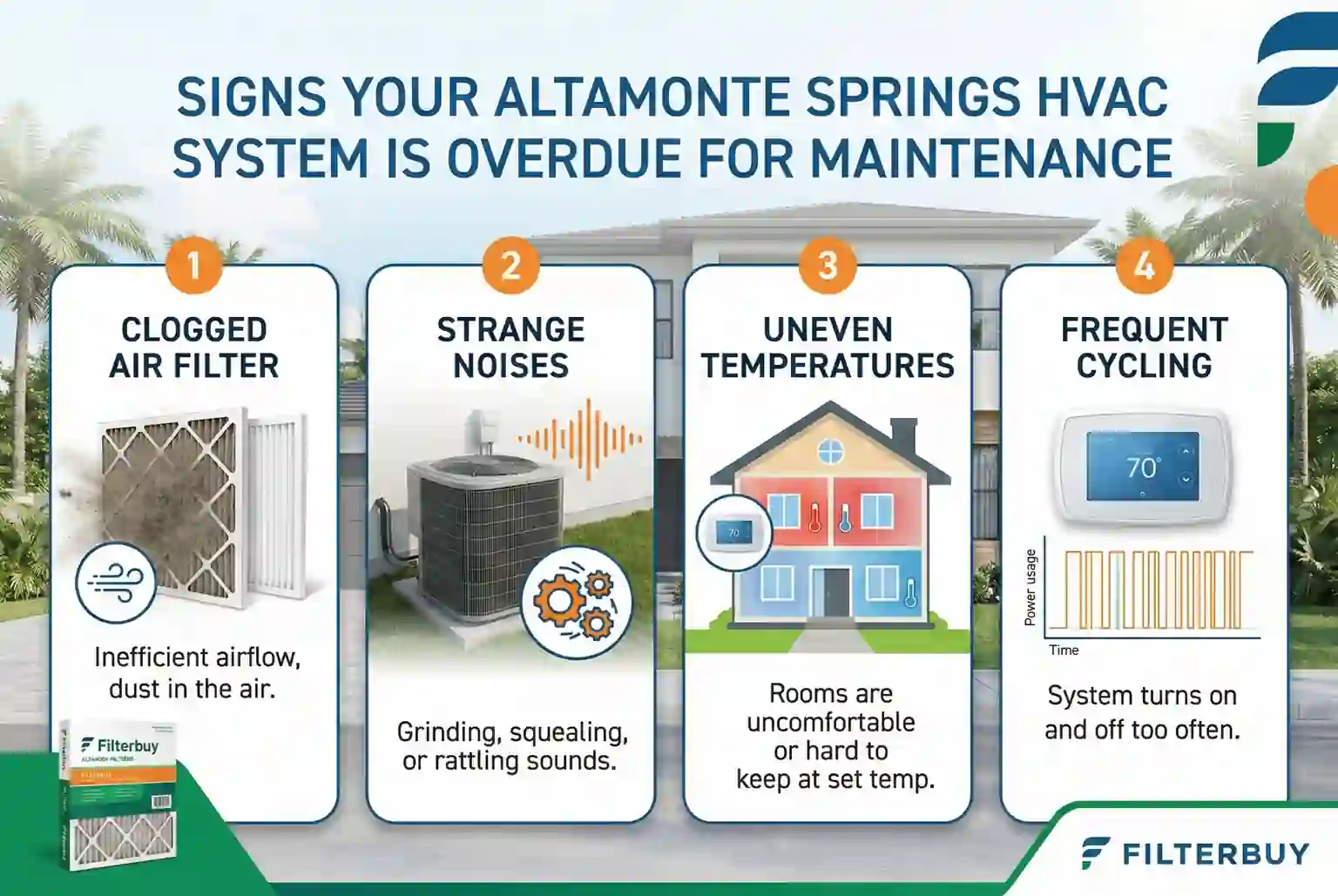
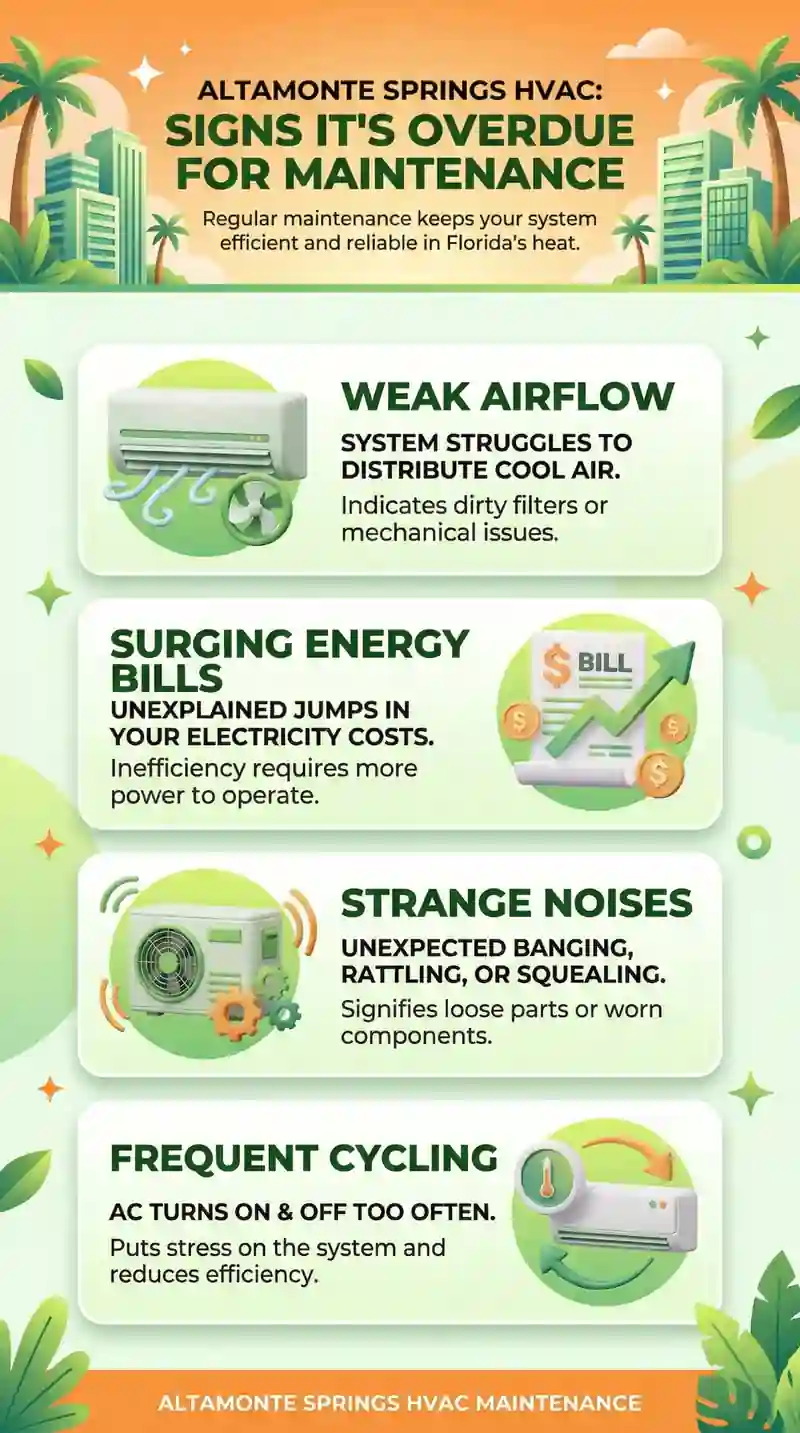
In Signs Your Altamonte Springs HVAC System Is Overdue for Maintenance, we explain that before obvious failures occur—like strange noises, weak airflow, or rising energy bills—your system often gives subtle clues rooted in poor performance and restricted airflow, and one of the simplest early indicators is a heavily loaded or incorrect filter. That’s why part of any pre-maintenance check should include looking at the filter size and condition, whether you’re using a correctly fitted 14x24x1 pleated furnace filter, a common 16x16x1 MERV 8 HVAC air filter 4-pack for routine dust control, or a compatible MERV 11 HVAC air filter when your system supports finer particle capture. Recognizing these telltale signs early—and addressing them through professional maintenance—can prevent small inefficiencies from becoming costly repairs and keep your system running smoothly in Altamonte Springs’ demanding heat and humidity.